What are the main cost differences between buying and leasing a shipping container in Australia?

Enquire now

Buying means one upfront cost (or a fixed interest-free payment plan) and then it's yours, with no ongoing fees. Leasing spreads the cost over time, but you're paying for as long as you keep the container, and the total cost can overtake the purchase price if you hold onto it for more than a year or so.

As a rough guide, a 20ft used container from Empire Containers costs from $3,344 on an interest-free lease-to-own plan (39 fortnightly payments), working out at around $6.12 a day. A new 20ft container is from $6,270 over the same term, or about $11.48 a day. Once it's paid off, there are no further costs. Leasing or hiring a container long-term, by contrast, means you keep paying every month for as long as you need the space, even after you've technically covered its value several times over.

Buying vs Leasing

Shipping containers in Australia

Buying
Leasing
Upfront cost
Higher (or spread via interest-free finance)
Low or no upfront cost
Ongoing cost
None once paid off
Long-term or permanent storage
Best for
Long-term or permanent storage
Short-term or seasonal needs
Minimum term
None
Typically 1 month, then month by month
Ownership
Yours from day one (or once paid off)
Never yours, must be returned
Resale value
Yes, containers hold their value well
None

How do shipping container delivery companies manage drop-offs in areas with limited access?

By matching the equipment to the site, and by solving it before the truck leaves the yard rather than on the day. For a tight site that usually means:

An access assessment first — photos or a site visit covering the entry point, driveway width, turning space, anything overhead, and the exact spot the container is going.

Choosing the right truck — tilt tray where there's length, side loader where there's width, crane where the container has to go over something.

Sizing down if needed. A 10ft or 20ft gets into places a 40ft never will, and two 20ft units are often the answer where one 40ft can't be delivered.

Staging the delivery. Where the truck can't reach the final position, the container can be set on nearby hardstand and moved the last few metres on rollers or skates.

Sorting the paperwork. If a crane or its exclusion zone has to occupy the road or footpath, road occupancy approval and traffic management is arranged in advance.

Very few sites are genuinely impossible. Most of the ones that look impossible just need a different truck or a different container.

BUY OR rent a shipping container

What ground conditions and clearance requirements are needed for safe delivery?

Ground first. The truck has to get in, carry the load and get out again. Concrete or existing hardstand is ideal, compacted road base or gravel is excellent, and firm dry ground is fine with footings. Trouble comes from fresh topsoil, recent landscaping backfill, wet clay, sand and saturated ground after rain, a bogged truck is slow, expensive, and usually the customer's cost to recover.

The container needs a level base within about 25mm across all four corners. It's a rigid box: leave one corner unsupported and the frame twists, and the doors stop opening and closing properly. Pads, hardwood blocks or railway sleepers under the corners fix that and keep the base out of the wet.
BUY OR rent a shipping container

Can a shipping container be delivered and placed in a backyard or confined space?

Often, yes. A side loader can set a container down about half a metre from the side of the truck, and can place over a low fence, which gets containers into a lot of backyards that look too tight on paper. Where side access is narrower than about 2.9 metres, taking out a fence panel for the delivery is common and quick. Where the truck can't get near the spot at all:
Crane it over. A crane truck can lift over a fence or a house, but reach and weight trade off hard against each other — a HIAB might only manage an empty 20ft at modest reach. Worth pricing properly rather than assuming.
Go smaller. A 10ft needs a much narrower access corridor and is far easier to place in a courtyard.
Move it the last stretch. Set it on the nearest firm surface and roll or skate it into position.
Rethink the position. Moving the drop spot three metres often turns an impossible delivery into a straightforward one.

Leave around 3 metres clear at the door end so the doors swing fully open, and tell us which end you want them facing before the truck leaves — turning a container around afterwards is another job in itself.

What type of truck or equipment is used to deliver shipping containers to difficult sites?

Four common options, each suiting a different kind of site.

Tilt tray (tilt slide). The tray tilts and the container slides off the rear as the truck eases forward. Simple and quick, our own truck does this for 20ft containers. It needs the length, around 20 metres of straight firm run, and it doesn't like slopes or soft ground.
Side loader (swing lifter). Two hydraulic cranes lift the container off the side of the trailer and lower it down. Needs width rather than length, works in a much shorter footprint, and places tight against a fence or between buildings, but it needs level ground, because a side loader parked across a slope isn't safe. We use a contracted side loader for 40ft deliveries.
Crane truck or mobile crane. The choice when the container has to travel over an obstacle. Needs overhead room, outrigger space, ground that will carry the outrigger loads, and often road occupancy approval.
Flatbed, with a forklift or handler at your end. Fine on hardstand sites where you have the lifting gear, check the rated capacity with your forklift supplier first, because capacity de-rates significantly with tine length and load centre.

How should I prepare my site before a shipping container is delivered to a hard-to-access site?

Run through this before arrival:

Confirm the ground is firm along the whole truck path as well as the drop spot, especially after rain.
Have footings in place — pads, blocks or sleepers, level within about 25mm across the four corners.
Clear the access corridor. Vehicles, bins, trailers, materials. Allow 3.5m+ width for a 20ft tilt tray.
Trim overhanging branches and check nothing sits below the truck's travel and lifting height.
Mark the drop position, and nominate which end the doors face.
Leave 3 metres at the door end for the door swing.
Check for underground services and septic tanks on the truck path and under outrigger positions.
Have someone on site to direct placement and make the call if something needs to change.
Open and close the doors before the driver leaves, to confirm the container isn't sitting racked.

Send us photos of your access and your drop spot and we'll tell you what's involved before you commit. Empire Containers delivers across New South Wales from our yard at 15 Marsden Street, Molong, and you're welcome to come and pick the exact container you want.

Enquire to buy or lease

Frequently asked questions

What happens if the truck can't get into my site?
We'd rather find out before delivery day than on it. Send us photos or a pin of the access, the gate, the driveway, the drop spot, and we'll tell you straight whether it'll work and which truck to send. If a tilt tray can't make it, a side loader or crane truck often can.
How much room do I actually need for a container delivery?
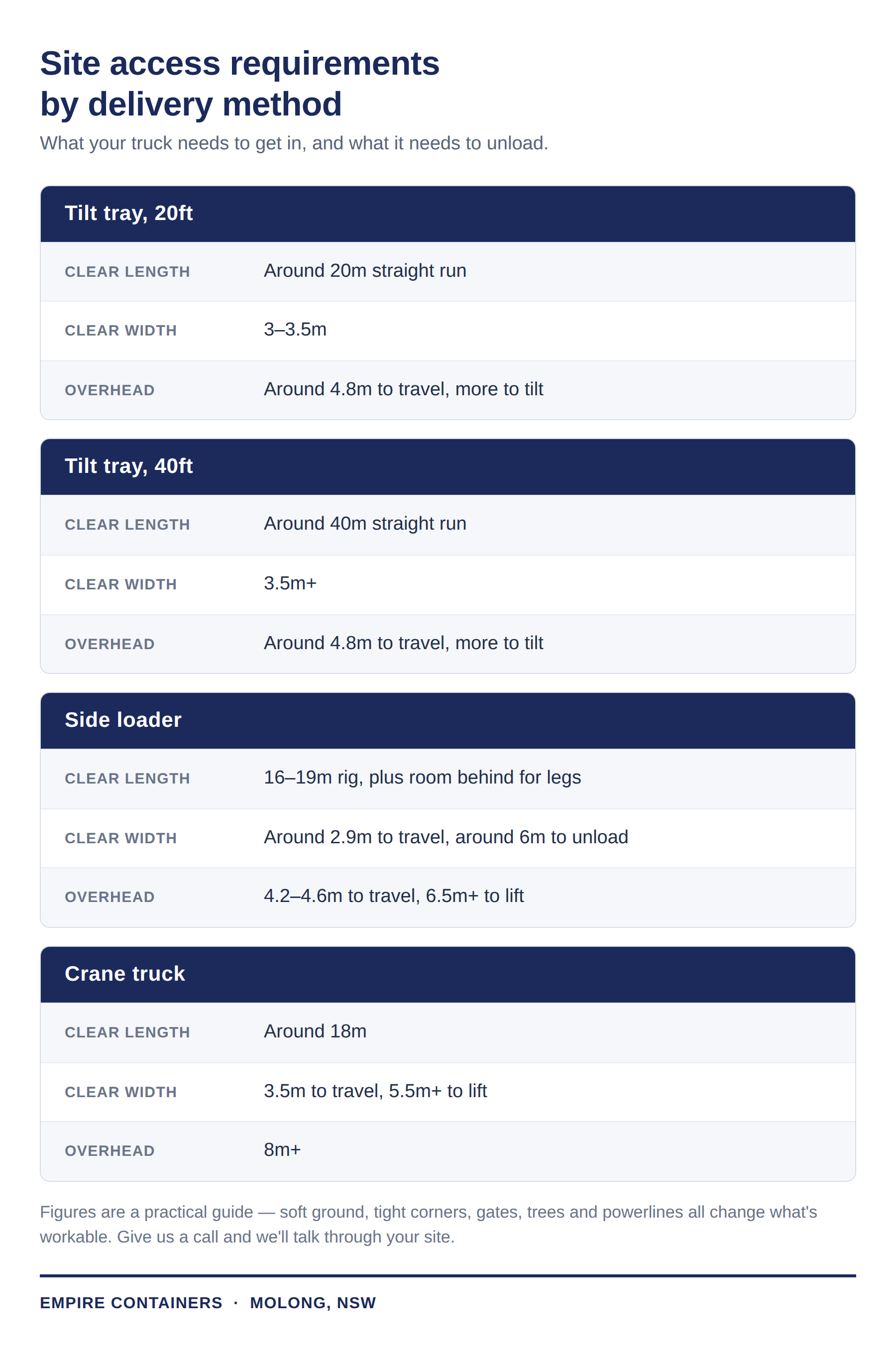
It depends on the truck, and length is usually the tightest constraint:
Tilt tray, 20ft — around 20m straight run
Tilt tray, 40ft — around 40m straight run
Side loader — 16–19m rig, plus room behind for legs
Crane truck — around 18m
On top of that you need width and height. A tilt tray wants 3–3.5m wide and about 4.8m of overhead to travel, more again to tilt the tray. A side loader gets in narrower (around 2.9m) but needs about 6m to swing its legs out and unload. A crane truck needs 3.5m to travel, 5.5m+ to lift, and 8m-plus overhead. Powerlines, low branches, awnings and tight corners catch people out more often than the gate does.
Do prices include GST?
Yes, all our lease-to-own prices include GST, with no hidden costs.
Can I inspect the container before I buy or lease?
Yes, you're welcome to visit our yard in Molong and choose the exact container you want.
BUY OR rent a shipping container

Contact the team at Empire Containers

Ready to find your perfect container solution? Reach out to the Empire Containers team today.

Enquire to buy or lease